How to Start a Domain Reseller Business Alongside Hosting (2026)
A domain reseller business works best as an add-on to hosting, not as a business on its own. The margin on a single .com is a few dollars a year, because every registrar starts from the same regulated cost: Verisign's wholesale price ($10.26 a year until 31 October 2026, $10.97 from 1 November 2026) plus ICANN's $0.20 fee. What you earn on domains is mostly convenience revenue and client retention. The hosting and care plan are where the money is.
Start reselling domains if you already host clients and want their renewals, DNS and billing in one place. Skip it if you'd be selling domains alone, because large registrars sell near cost and you can't beat them on price. This guide covers the cost floor, three ways to set up, and the ownership rule that protects you and your clients. Wholesale figures are from Verisign; retail prices are dated next to each one.
The cost floor every registrar starts from
Verisign runs the .com registry and may only sell to accredited registrars, at a capped price. On its April 2026 earnings call it gave notice of a $0.71 rise in the annual wholesale price, from $10.26 to $10.97, taking effect on 1 November 2026, and said registrars are free to set any retail price they like. Add the $0.20 ICANN fee charged per domain-year and the floor for one .com year moves from $10.46 to $11.17. That is our arithmetic on the published figures.
Retail renewal prices sit well above that floor at most hosts, and close to it at a few low-margin registrars. The chart shows the gap that a reseller works inside.
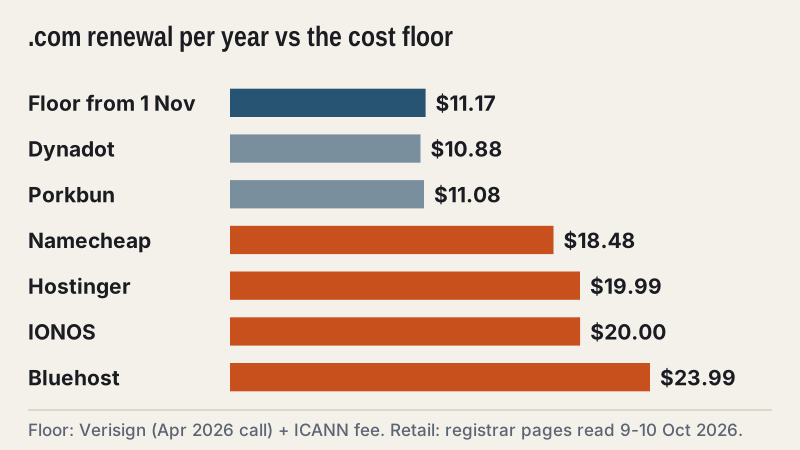
Two of those retail prices, Dynadot's $10.88 and Porkbun's $11.08, were already at or under the post-November floor when we read them, so expect them to move. Treat every figure here as a snapshot. For a reseller the point is simple: if your clients can renew a .com for about $11 elsewhere, a $25 renewal from you has to come with something they value, such as you handling DNS, email records and renewals without being asked.
Three ways to resell domains
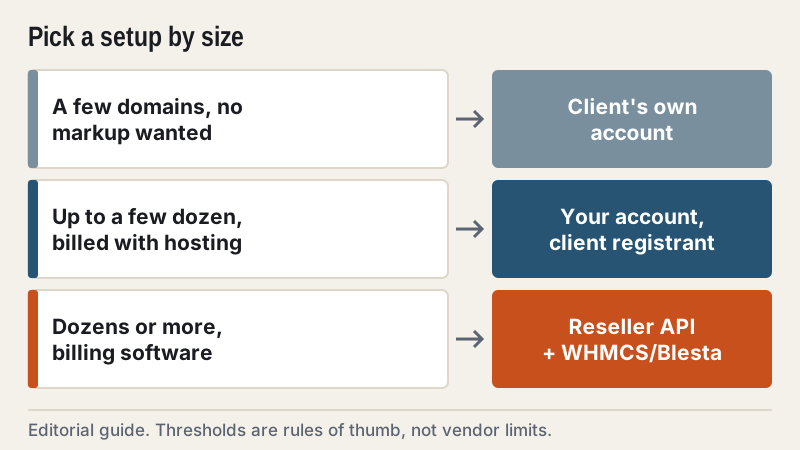
There's no single "domain reseller account". In practice resellers use one of three setups, and the right one depends on how many domains you manage and how much you want automated.
- Register in each client's own registrar account. You set it up, the client owns the login and pays the registrar directly, and you bill for your time. No margin on the domain, no risk if you part ways.
- Manage domains in your own registrar account, registered in the client's name. You pay the registrar, invoice the client with your markup, and keep renewals on your calendar. This is how most small hosting resellers start.
- A registrar reseller or API program connected to billing software. Domain orders, renewals and invoices run automatically through WHMCS, Blesta or similar. Worth it once you handle dozens of domains.
| Setup | Registrant | Who pays the registrar | Your margin | Automation |
|---|---|---|---|---|
| Client's own account | Client | Client | None (bill your time) | None needed |
| Your account, client as registrant | Client | You, then you invoice | Your markup | Manual or calendar |
| Reseller program or API + billing app | Client | You, via prepaid balance or card | Your markup | Orders and renewals automatic |
Automating it: APIs and billing software
Automation is where reselling stops being admin. Billing tools such as WHMCS and Blesta use registrar modules to register, renew and transfer domains when a client pays an invoice. Our guide to billing software for resellers covers which hosts include a licence. Namecheap, for example, lists a WHMCS Starter licence as an $8 a month add-on on its reseller hosting plans (read 18 Oct 2026). See Namecheap's reseller plans.
Registrar APIs come with conditions. Namecheap's developer page, read on 18 Oct 2026, offers a free sandbox with no restrictions for testing, but production API access is only switched on for accounts that meet its requirements, and you must whitelist at least one IPv4 address before calls work. Test every order, renewal and transfer flow in a sandbox before you connect live billing, because a failed renewal is the one mistake clients remember.
Some reseller hosting plans also include a domain for the first year. ChemiCloud's reseller page, read 18 Oct 2026, offers a new domain free for year one on a 12-month or longer reseller plan, renewing at the regular rate. That's your domain, not a client's, but it helps when you're setting up your own brand. See ChemiCloud's reseller plans.
Ownership: register every domain in the client's name
Whatever setup you use, the client should be the registrant: the legal holder named in the registration. You can be the account holder or a technical contact, but not the owner. If the relationship ends, a domain in the client's name is a clean handover. One in yours becomes a dispute, and their business is held up while it's argued over. Our white-label hosting guide explains how to keep the branding yours while the assets stay theirs.
Bill for the domain, but never own it. A reseller who holds client domains hostage loses the client and the reputation together.
Pricing domains for clients
Price domains like hosting: from your renewal cost, not the first-year promo. If your registrar charges you $18.48 to renew a .com and you bill $25, your margin is $6.52 a year before card fees. If you can buy close to the $11.17 floor, the same $25 leaves about $13.83. Either way, the number is small next to a hosting or care-plan fee. Many resellers fold the domain into a monthly plan instead of invoicing it separately, which also avoids the annual "why is this so expensive?" email. Our reseller pricing worksheet shows the same arithmetic for hosting.
Edge cases
- A client's domain sits with a previous designer. Ask the client to request the transfer code themselves; you can't transfer a domain you don't control.
- Country-code domains. Some ccTLDs have residency or registrant rules, so check before you promise one.
- Price rises mid-term. Wholesale increases apply at renewal, so a client who prepaid several years is protected for that term. Your margin isn't, if you invoice yearly.
- Expiry on your watch. Turn on auto-renew and keep a funded payment method. An expired client domain is the fastest way to lose the hosting account too.
Domains round out a reseller offer, but the host behind your plan matters more. Compare reseller plans by renewal price per client in our best reseller hosting ranking.
Domain reselling: FAQ
How do I start a domain reseller business?
Is domain reselling profitable?
What is the .com wholesale price in 2026?
Should the domain be in my name or my client's?
Do I need to be ICANN-accredited to resell domains?
Next step: compare the best reseller hosting plans, ranked, or read how to start a reseller hosting business.